Realities and Practices on the Ground
From the outside, the Turkish procurement system appears to be surrounded by complex legislation, technical documentation and a bureaucratic structure. However, once you get inside, the basic dynamics of the system are clear: The contracting authority creates a framework; when companies read this framework correctly and prepare bids by analyzing their costs realistically, the process becomes manageable.
The problem is that the process is more technical, more analytical and more disciplined than it seems.
This article summarizes in plain language both the regulatory side of the tendering process and the realities on the ground, explaining why companies struggle and what the right approach should be.
1. The Basis of Tender Logic in Turkey: The Contracting Authority Draws the Framework
Construction tenders in Turkey are based on three main elements:
- Projects
- Specifications
- Approximate cost
Approximate cost is one of the most misunderstood concepts in the sector.
Some firms still think that “if we know the approximate cost, we can solve the tender”. However, the approximate cost is only the contracting authority’s own assessment; it has no direct link to the firm’s bidding strategy.
The right approach is for the firm to subtract its own cost, add its analysis-based profit and create a line-item-based logic.
Approximate cost is the administration’s. Bid analysis is the firm’s world. When these two worlds are confused, the strategy collapses.
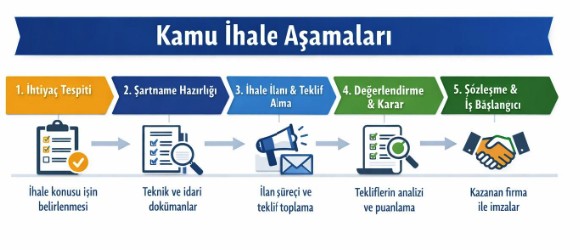
2. Actual Flow of the Tender Process
Although theoretically it looks like an orderly process, in practice each stage requires serious technical discipline.
1) Reviewing the Documents
Administrative specifications, technical specifications, draft contract, special conditions… It is essential to verify that these documents do not contradict one another.
2) Reviewing Projects
This is the area where companies most often make mistakes. When projects are rushed through and the focus shifts to pricing the proposal, from the ground up weak a structure it becomes.
3) Quantity Surveying and Estimation
Accurate quantity surveying → accurate cost → accurate bid is the first link in the chain. Incomplete or inaccurate quantity surveying determines the fate of the bid.
4) Unit Price Analyses
The cost of each work item must be clearly calculated, taking into account the components of materials, labor, equipment, overhead, and profit. Superficial analyses can cause problems in cases of excessively low bids.
5) Preparing the Proposal
At this stage, two factors are important:
- Opponent reading
- Own cost security
Bids centered on approximate cost are often risky.
3. 5 Most Challenging Points for Companies in Turkey
- Incomplete or incorrect quantity
- Weak unit price analysis
- Misinterpretation of boundary value logic
- Lack of documentation discipline
- Putting the approximate cost at the center of the bidding strategy
Any of these mistakes can lead to the elimination of a seemingly good offer.
4. Limit Value: The Most Misunderstood Concept
The threshold is not a line that determines the winner; it is a technical tool used to detect excessively low bids.
In reality there are two basic principles:
- The limit value does not win the tender.
- It eliminates the company with weak analysis.
Reading the limit value correctly is an advantage in itself.
5. Excessively Low Bid Explanation: The real test of the process
It is one thing to win a tender; it is quite another to pass the ultra-low disclosure.
The most common mistakes:
- Proforma and catalog mismatches
- Irrational labor analysis
- The documents in the market research do not meet the criteria
- Deficiencies in machine-equipment descriptions
- Incorrect use of similar work
The extreme abortion process has only one criterion: Logic and consistency in analysis.
6. The Real Tender Winning Strategy: Analysis Discipline
The offer figure is only the visible part of the preparation. It is the discipline of preparation that determines the real gain.
Winning approach:
- Establishing the project-quantity-discovery chain correctly
- Analyzing the actual cost
- Special management of risky business items
- Reading the limit value correctly
- Not approaching the offer only with the logic of low price
Competition is shaped in favor of companies with strong preparation.
7. Four Clear Recommendations from Experience
- Do not bid for work without a project.
- Don’t get excited when you hear the approximate cost.
- It is the analysis that wins the bid, not the number.
- Documentation discipline gains tender.
8. Conclusion
The procurement system in Turkey is not as complex as it is perceived to be; it is detailed. For those who know how to manage the details, the process is clear and predictable.
Success in a tender starts with the right analysis and the right strategy. The accuracy of the project-quantification-discovery-analysis chain, not the approximate cost, determines the outcome.