“Your analysis, not the market, determines the auction price.”
In the world of tendering, the bid figure is not a “quick calculation” as many people think. The backbone of a bid is the unit price analysis. When these analyses are not done correctly:
- Even if the bid is low, he won’t win,
- even if it wins, it cannot pass the extremely low description,
- even if he gets the job, he’ll make a loss on the construction site.
Many companies in Turkey fall behind in the competition because they treat the concept of analysis superficially. However, analysis is the most technical and strategic point of a tender.
This article explains in a simple but professional way what unit price analysis is, how it should be done and who really determines the price in a tender.
1. What is Unit Price Analysis?
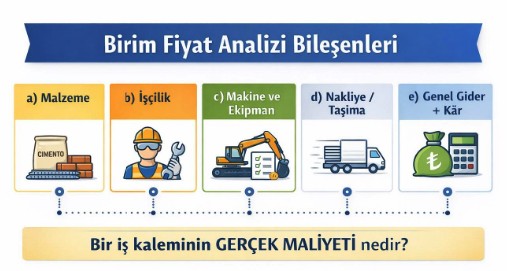
Unit price analysis is the detailed calculation of all the components that make up the actual cost of an item of work.
Within each work item there are five key elements:
- Material
- Labor
- Machinery and equipment
- Handling / transportation
- Overhead + profit
The sum of these five elements is the firm’s answer to the question “what will I spend to do this work item?”.
Unit price analysis is the DNA of the company.
2. Who Actually Determines the Unit Price?
The most common wrong assumption in the sector: “The approximate cost determines the price.”
The reality is that the company sets the price, not the administration. But there are two elements that bind the company:
- its true cost,
- price behavior of competitors.
The approximate cost belongs to the world of the contracting authority; it does not directly determine the firm’s bidding process.
The main factor determining the price is the analysis. The more accurate the analysis, the more competitive and secure the offer.
3. How are the components of a unit price analysis calculated?
a) Material Cost: Material should be calculated including market research, supplier selection, quality, brand and transportation. Superficial prices taken from the catalog are not accepted as excessively low.
b) Labor Cost: Daily labor cost, productivity, working time and the nature of the work should be evaluated together. The most common mistake is made in labor analysis.
c) Machinery and Equipment: Hourly/daily usage cost, depreciation, fuel and operator expenses should be taken into account. Undocumented explanations will be rejected.
d) Overhead and Profit: The aim is not to offer the lowest price, but to create a sustainable price.
e) Shipping and Handling: Long distance jobs can significantly increase the cost of transportation. Neglecting this item will lead to the collapse of the offer.
4. Risks of Bidding without Analysis
“I’ll just add X percent to unit prices and that’s it.” This approach generates three major risks:
- Risk of elimination in extreme low disclosure
- Risk of loss in the middle of business
- Risk of delay and inability to manage the construction site
A company that does not analyze bids by chance, not by tender.
5. The Role of Analysis in the Extreme Low Bid Process
The ultra-low explanation is a technical x-ray of the tender. The Commission asks the following questions:
- Can it be done at this price?
- Does this price make sense?
- Is the documentation and analysis consistent?
Incomplete analysis → inconsistent price → elimination.
Analysis is therefore decisive not only at the proposal stage but also in the defense of the proposal.
6. Reading Competitor and Market Behavior
Analysis is not just math; it is strategy.
- Previous auction prices
- Regional competitive intensity
- Behavior of large firms
- SME trends
- Public investment periods
Without this reading, the analysis, even if technically correct, is strategically incomplete.
7. Unit Price Analysis = Risk Management
A work item depends on many risks on site, such as labor performance, material availability, ground conditions, seasonality and equipment density.
If you see the risks during the analysis, you can set your price strategy correctly. If there is no analysis, the risks appear after the auction.
8. 7 Common Analysis Mistakes Companies Make
- Analyzing the incomplete bill of quantities
- Miscalculating labor productivity
- Not determining realistic machine hourly rates
- Keeping transportation low
- Choosing the overhead + profit ratio by heart
- Conducting market research with a single supplier
- Superficially pricing risky items
These mistakes generate risky bids, not profitable ones.
9. Conclusion: Analysis, Not the Bid Form, Determines the Price
What determines competition in a tender is not the environment but the discipline of analysis.
Proper analysis ensures that:
- The offer will be solid
- You are not afraid of extreme miscarriage
- If you take the job, you won’t make a loss
- Move up to the top league in professional competition
In the world of tenders, winners do not emerge by chance, but among those who can analyze. Unit price analysis is not just a table; it is the strategic mind of the company.