Eligibility Criteria, the Bidding Documents, and the True Nature of the Screening Mechanism
While many companies in Turkey consider themselves qualified for national tenders, they lack the same confidence when it comes to World Bank-funded projects.
The reason isn’t that the processes are difficult; it’s that they’re different.
The World Bank’s procurement system differs entirely from the framework of Law No. 4734 in Turkey.
Here, it is not the lowest price that matters, but rather the combination of qualifications–experience–documentation.
The summary is as follows:
You compete not by undercutting prices, but by accurately assessing your capabilities.
In this article, I explain the realities of World Bank-funded construction projects, covering all aspects from the structure of the bid documents to the selection criteria, from qualification requirements to Bank oversight.
- The Philosophy of the World Bank’s Procurement System:
“Quality First, Price Second”
The World Bank’s overall procurement approach is based on three pillars:
- Transparency
- Competency-based assessment
- Respect for the administrative decision of the administration + Bank audit
While price is often the deciding factor in public tenders in Turkey, at the World Bank, price alone is not the determining factor.
For a company to be awarded a contract, it must first demonstrate that it has the capacity to carry out the work.
For this reason, the section the Bank considers most important is the Qualification Criteria section.
- World Bank Qualification Criteria
This is the section where applicant companies struggle the most.
Because it is prepared in accordance with international standards, and the criteria are very clear.
Eligibility for World Bank projects is assessed under the following categories:
1) Similar Work Experience
- Projects completed in the past 5–10 years
- “Similar nature and complexity” şartı
- Verification of completion certificates in an international format
The area where Turkish companies struggle the most:
The project does not align with the similar one in terms of scale, complexity, and technical content.
2) Financial Capacity
- Annual revenues
- Business volume
- Liquidity
- Financial ratios
The World Bank wants the company to be capable of financing its operations .
3) Key Technical Staff
- Project Manager
- Control Engineer
- Mechanical/electrical engineers
Even the CV format for these employees is standardized.
4) Sufficiency of Machinery and Equipment
- List of equipment to be used on-site
- Ownership or lease documents
- Special requirements for critical machinery
5) Joint Venture (JV) Terms and Conditions
- The lead partner must hold at least a 40% stake
- Criteria that each partner must meet individually
- Combined & individual criteria ayrımı
An incorrect JV structure → is a surefire reason for disqualification.
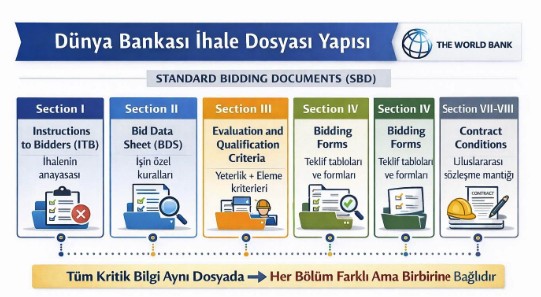
- World Bank Bidding Documents (Standard Bidding Documents – SBD)
The World Bank’s documentation is far more complex than the typical administrative and technical specifications used in Turkey.
Critical sections in an SBD file:
- Section I – Instructions to Bidders (ITB)
The constitution of the tender.
- Section II – Bid Data Sheet (BDS)
The section where the specific rules of the job are outlined.
- Section III – Evaluation and Qualification Criteria
This is where the true fate is decided.
- Section IV – Bidding Forms
Everything from the proposal letter to the staffing tables.
- Section VII & VIII – General & Particular Conditions of Contract
International contract logic (high FIDIC influence).
Companies usually only read the “technical specifications” section of the document;
The main area where points are lost is the ITB + BDS + Evaluation section.
- The World Bank’s Screening Mechanism (Responsive / Non-Responsive)
In World Bank tenders, the selection process is based not on speculation, but on clear rules.
If a bid does not meet any of these criteria, the outcome is clear:
Non-Responsive → Red
The most common reasons for elimination:
- Lack of similar work
- Failure to meet financial criteria
- Forms filled out incorrectly or incompletely
- Failure to properly establish the joint venture structure
- Technical staff CVs not following the required format
- The documents cannot be verified
There is no such thing as “the administration turning a blind eye” in the World Bank system.
Missing documents = automatic disqualification.
- Government–Bank Relations:
Who Makes the Decision?
Most companies confuse these two concepts.
In World Bank projects, the process works as follows:
- The entity making the technical decision: The Administration
The project, survey, specifications, and technical evaluation are the responsibility of the administration.
- The process is overseen by: the World Bank
The bank intervenes in the following areas:
- Procedural errors
- Violations of transparency
- Non-compliance with evaluation criteria
- Inconsistencies in the pre-qualification phase
The bank’s key strength:
Approval of the Contract Award Recommendation.
The company selected by the administration, If the bank deems it unsuitable the process will be returned to the beginning.
- Where Do the Challenges of Getting Involved in These Projects Begin?
The challenges faced by most companies in Turkey:
- Preparing documents in English
- Proof of work experience in an international format
- Compliance with financial ratios
- The complex structure of Bidding Forms
- Misunderstanding of JV criteria
- Non-compliance of catalogs and personnel documents with the standard
That’s why companies usually say, “The risk is too high; let’s not get involved.”
The real issue isn’t the difficulty; it’s a lack of expertise.
- Why Is Professional Support Essential?
(Not a soft sell, but a genuine need)
Risks faced by an inexperienced firm in World Bank tenders:
- Incomplete or incorrect documents → Immediate disqualification
- Similar job mismatch → Not considered
- Incorrect JV → Bid invalid
- Form errors → Non-responsive
- Inconsistency between technical and financial criteria → Excluded from evaluation
For this reason, companies are often eliminated simply because they are unfamiliar with the process, even though they possess the necessary qualifications.
This is where professional support comes in:
- The file is prepared correctly
- Competence is properly structured
- If the JV strategy is properly planned
- The documents are prepared in accordance with international standards
- The evaluation criteria are fully met
In short:
It doesn’t take the company out of the race; on the contrary, it puts it right in the thick of it.
- Result:
World Bank Tenders Are Not Difficult, but They Require Expertise
World Bank-funded construction projects are still considered “difficult” by many companies in Turkey.
In fact, the process isn’t scary; it’s just different.
If a company wants to participate in these projects:
- You must understand the eligibility criteria correctly
- You should read the bid documents carefully
- Documents in an international format should be prepared
- The joint venture structure must be properly established
- You should understand the evaluation process
Once these conditions are met, competition becomes much more intense and opportunities grow.
Companies that want to participate in World Bank projects but don’t know where to start don’t need luck; they need the right guidance.