The Real Reason Behind Explanations for Excessively Low Bids!
The most critical juncture in construction tenders in Turkey is the threshold value and explanations for abnormally low bids.
The phrase you hear most often on the field is usually this:
- “If I stay above the limit then I win.”
- “Let’s just not end up with an extremely low score.”
- “It’s up to me, but I don’t know how I’m going to explain it.”
These sentences do not reflect the correct approach.
In reality, the threshold value does not determine the winner, while the “excessively low” explanation is a test of the bid’s validity.
Without the right analysis, sound reasoning, and proper documentation, no company can survive this process.
In this article, I explain the true logic behind the threshold value, how the process for explaining excessively low bids works, and why companies are disqualified, using simple yet professional language.
- What Is a Threshold Value? What Is It Actually Used For?
The threshold value is a technical calculation used to identify levels at which bids in a tender may be deemed “excessively low” by analyzing the bids using a specific calculation method.
Common misconceptions:
- “Any value above the threshold is definitely included.” → Incorrect
- “We’ve exceeded the threshold; the job is done.” → Incorrect
The correct answer is:
- The threshold value identifies only risky low prices.
- Sınır değer kazananı belirlemez, sadece “kim açıklama yapacak” sorusuna yanıt verir.
The significance of the threshold value for management is to determine whether the prices set by firms are realistic; for the firm’s strategy, it is to determine whether the offer is defensible.
- How Is the Threshold Value Calculated? (Summary of the Logic)
The limit formula itself is not dangerous; what is dangerous is misinterpreting it.
The basic logic of the calculation:
- The average of the bids submitted for the tender is calculated.
- Prices that are likely to be excessively low are filtered out.
- A weighted calculation is performed on the remaining bids.
- Result → Boundary Value.
If the bid is below the threshold:
- The company excessively low explanation must provide.
If it remains on:
- A description is not required,
- But that doesn’t mean he’ll win.
- Explanation of an Excessively Low Bid:
The Real Test of the Tender
If submitting a bid in a tender is worth 10 points, passing the excessively low bid review is a 100-point process.
Because at this stage, the committee isn’t just looking at the numbers; it wants to see the reasoning behind the numbers.
The core of the “extremely low” statement:
- Analyses (reasonable costs for each work item)
- Market research (at least 3 suppliers meeting the criteria)
- Pro forma invoices (in the appropriate format and meeting the criteria)
- Catalogs (compliant with the technical specifications)
- Labor calculations (productivity–hours–days)
- Machinery and equipment descriptions (documented–realistic)
If the analysis is weak → the explanation falls apart
If the pro forma is incorrect → the explanation fails
If the catalog is invalid → the description fails
An explanation of an extremely low score is not a battle of documents; it is a test of logical consistency.
- The Commission’s Explanation of the Abnormally Low Price
The Commission considers three questions:
1) Can this job be done at this price?
If it is as low as possible → it is eliminated.
2) Are the documents consistent?
If the pro forma and the analysis do not support each other → it is eliminated.
3) Is the analysis logical ?
For example:
- If a task meant for 5 people is shown as being done by 2 people
- Machine hourly wage market realities is disconnected from
- Material price is too low
The result remains the same → is eliminated.
This stage reveals the company’s “financials.”
No company without a strong analytical discipline can survive this process.
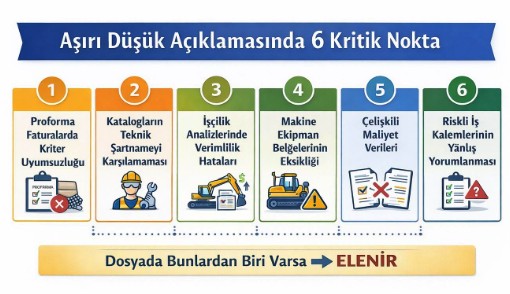
- The 6 Locations with the Highest Number of Dismissals
- Discrepancies in criteria on pro forma invoices
- The catalogs do not meet the technical specifications
- Efficiency errors in labor cost analyses
- Lack of machinery and equipment documentation
- Inconsistent cost data
- Misinterpretation of high-risk items
If even one of these six items is included in the analysis file, the outcome of the proposal is often a foregone conclusion: REJECTED.
- Limit Of the value Strategic As Incorrect Use
The biggest mistake companies make is this:
“Let’s just set the price based on the threshold value.”
This approach is flawed for two reasons:
1) The boundary value varies within the year.
Every auction yields a different result.
2) A threshold value is not a strategy; it is a filter.
Getting past the filter is not a strategy.
Strategy → thorough analysis + accurate price assessment.
A firm that bids based on the threshold value is a firm that acts on behalf of another party.
- The Golden Rule for Explaining an Extremely Low Score:
Analysis Consistency
For an analysis file to be considered valid, three consistency conditions must be met:
- Internal consistency
The analyses will not contradict themselves. - External consistency
Market data consistent will be. - Technical consistency
Specifications and project logic compliant will be.
If these three conditions are not met, the explanation will be rejected.
- Result:
A Threshold Value Is Not Destiny; Analytical Discipline Determines Destiny
The threshold value is part of the tender; however, it is not the factor that determines the winner of the tender.
The factor that determines the final outcome:
- the discipline of analysis,
- cost logic,
- technical compliance,
- properly structuring documents
- and consistency
is the approach.
A “materially adverse” disclosure is not a process to be feared; it is an advantageous process for those who are well-prepared.
This is precisely the test that best demonstrates a company’s professionalism.